 Home
Home
The North Devon and Cornwall Junction Light Railway
Visitors to Okehampton Station in the summer of 2025 will have seen the Festival of Devon in the 1920s information boards in the booking hall. The entire festival programme is a fascinating insight into life in Devon a century ago, but of particular interest from a railway perspective is the board relating to our close neighbour the North Devon and Cornwall Junction Light Railway from Halwill Junction to Great Torrington. The ND&CJLR was the last railway to be built in Devon, opening on July 27th 1925.
We are grateful to historian Julia Neville, project manager for the exhibition and author of the ND&CJLR board, for permission to use the board’s content, reproduced herewith (with some format amendments to suit the website):
Approval for a railway joining the town of Torrington to Halwill, where trains from Okehampton already divided to run to Bude and to Launceston, had originally been given in 1909. Mr Stephens, the engineer and proposed managing director, had just completed a light railway from Bere Alston to Calstock which had made him known in the county. But because of funding difficulties and the war it was not until 1921 that the project, under the now ‘Colonel’ Stephens, was revived.
 Map of the ND&CJLR route. We are grateful for permission to use this very clear and informative map of the railway, produced specially for the exhibition by Andrew Lathwell of Lathwell Creative |
The case for the railway was strong. It would improve the transport of clay between the pits at Marland and the coast. Removing the transport of heavy goods and farm animals from the roads would reduce the need for road repairs. The project would reduce unemployment, which had risen to 23%. It would make for speedier journeys from Plymouth to north-west Devon and would reduce rural isolation.
After a good deal of discussion about how the railway should be funded, the Ministry of Transport offered a grant of £125,000 if a similar amount could be raised locally. Local authorities promised funds, and Lord Clinton, the most significant landowner in the area, invested, and also donated land, but much was raised by small investors encouraged to lend money at public meetings around the area.
The work began with a turf-cutting ceremony on June 30th 1922. Progress was slow. There was an extremely wet summer in 1923 which made it difficult to lay out the steep curves and embankments.
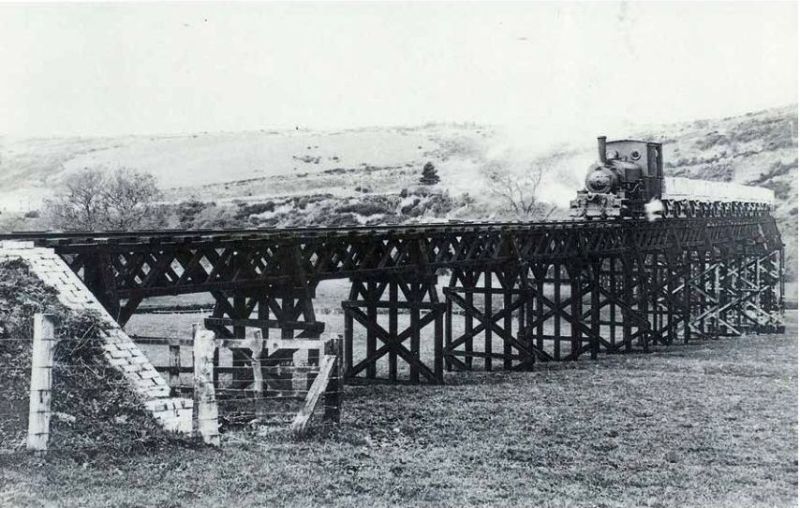 The original narrow gauge railway south from Torrington for ball clay traffic |
Some of the workers said that conditions were worse than on the Western Front. The trenches they cut filled three foot (one metre) deep with water. Much of the work was far away from any village shop or pub or lodgings. Some of the men lived in bell tents. There was no heating and no running water.
Finally by the summer of 1925 the line was completed. Colonel Stephens took a party of official dignitaries and landowners on a trip down the line on Friday July 23rd, stopping at each station to inspect the construction. On Monday July 27th the official timetable began with the 0630 down from Torrington.
The railway was never as busy as expected. Road traffic became more popular. The speed restrictions for light railways meant that the trains took an hour and a half to make the complete journey. Although the clay industry kept the northern line busy the through trains remained at three a day, never increasing to the five originally proposed.
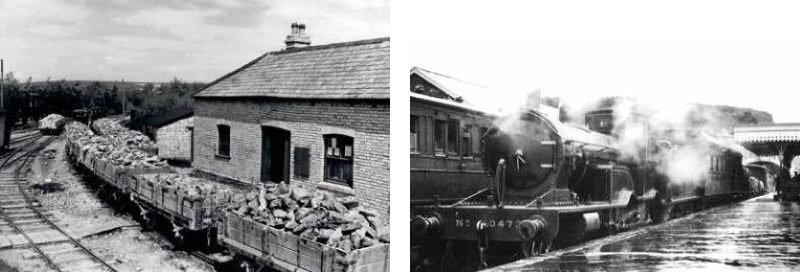 Left: Ball clay loaded at Peters Marland. Right: A 460 class express passenger locomotive waiting at Torrington Station. Built by Robert Stephenson, it entered service as LSWR 473 in June 1884. It was renumbered 0473, transferred to the Southern Railway in January 1923 and withdrawn from service in October 1928. |
PDF downloads - display board
 (385Kb) map only (114Kb).
Some related links:
Devon in the 1920s Festival website
Colonel Stephens Society
Tarka Valley Railway